

Retail Supply Chain Transformation: The Real Bottlenecks Lie Between Functions
Retailers rarely lack transformation goals. Improving forecast accuracy, reducing inventory, accelerating stock turnover, increasing product availability, and supporting omnichannel fulfilment are typically already embedded in strategic plans and translated into system implementation and business improvement initiatives.
The real difficulty often emerges when these goals enter day-to-day operations. The merchandising team launches a promotion, but the supply chain does not adjust inventory in time. The system shows that a store has stock, yet customers cannot find the product when they arrive. Headquarters generates replenishment recommendations using forecasting models, but stores continue to amend orders based on experience. Online orders keep growing, while warehouses, stores, and delivery networks operate under different fulfilment rules.
These issues may appear unrelated, but they often share the same underlying cause: The greatest bottlenecks in a retail supply chain rarely sit within one department or one system. They arise at the points where different functions, processes, and systems must connect.
Supply chain transformation should therefore not be understood simply as replacing systems or improving logistics. It is closer to a redesign of the operating model. Retailers must clarify how demand is identified, how inventory is allocated, who is responsible for resolving exceptions, and how different teams make consistent decisions.
1. The Supply Chain Is Not a Back-Office Function, but a Connecting System for Retail Operations
In traditional organisations, the supply chain is often treated as an execution function positioned between procurement and stores, with responsibility for ordering, warehousing, transportation, and replenishment. In modern retail, however, the supply chain directly connects merchandising strategy, channel operations, and customer experience.
The success of a promotion depends not only on pricing and communication, but also on whether the right products reach stores on time. The credibility of an omnichannel promise depends not only on the customer-facing interface, but also on inventory accuracy and the correct allocation of orders. The ability to scale a new product depends on whether demand signals can be incorporated quickly into procurement and replenishment decisions.
Customers see whether a product is available. Retailers must manage the entire chain connecting demand, inventory, orders, and fulfilment.
This is why supply chain issues are difficult for any single department to resolve independently. In its analysis of omnichannel supply chains, McKinsey has noted that genuine transformation requires changes to organisational structures, business processes, and individual responsibilities, rather than isolated improvements to one part of the operation.
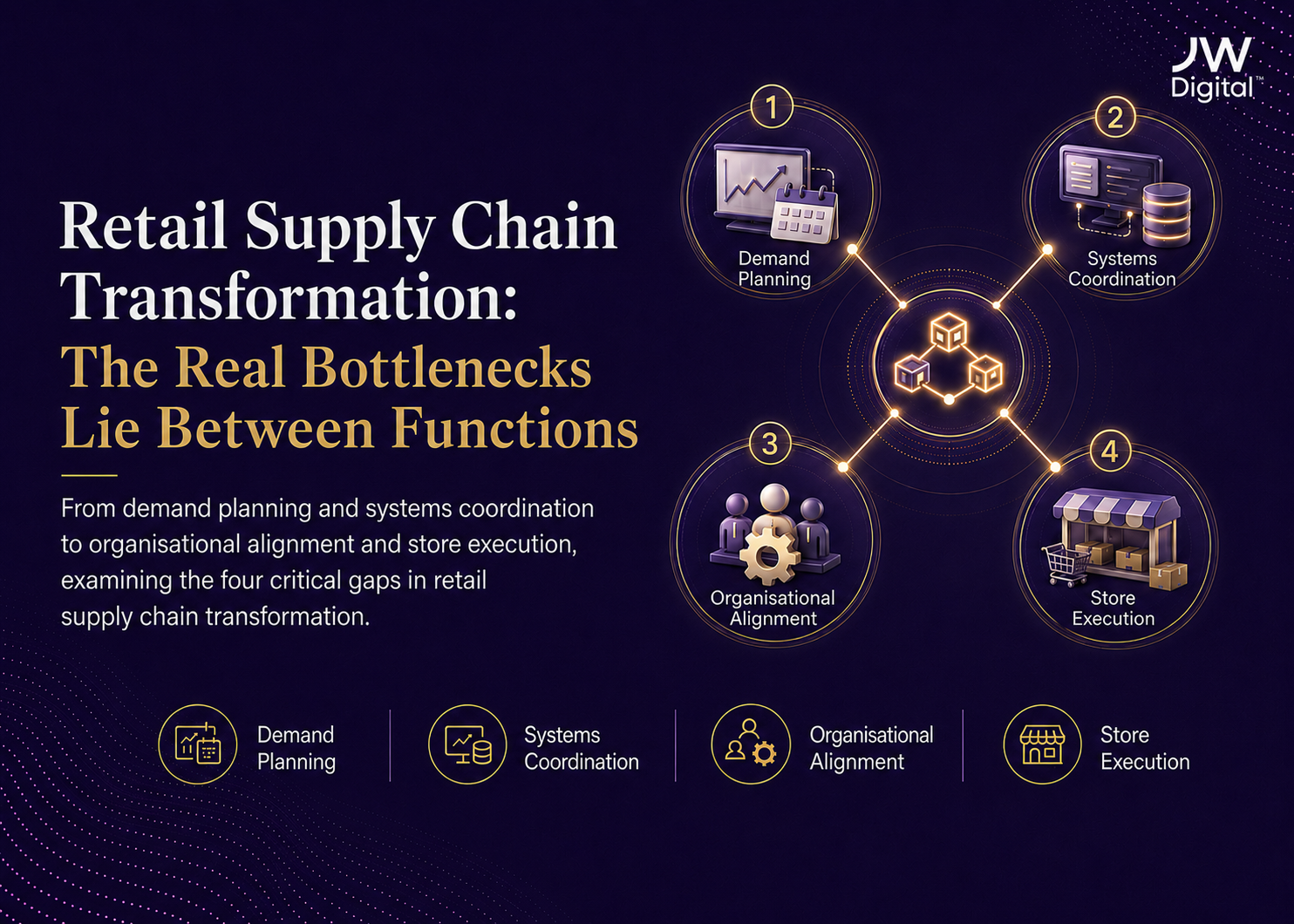
2. Why Supply Chain Transformation Stalls: Four Critical Gaps
Gap One: Demand Planning Is Disconnected from Commercial Reality
Supply chain planning usually begins with forecasting, but forecasting is not the ultimate objective. What retailers actually need is the ability to adjust procurement, allocation, replenishment, and fulfilment quickly as market conditions change.
In practice, demand information is often dispersed across the organisation. Historical sales data sits in POS systems. Promotion plans are managed by marketing teams. New-product plans are developed by merchandising. Online traffic is monitored by e-commerce teams. Supply chain planners may receive only part of this information.
As a result, even a technically accurate forecast may fail to capture imminent changes in the business. A last-minute promotion may not yet be reflected in the system. Store-level activity may differ from the plan developed by headquarters. Demand changes caused by weather or local events may not be communicated in time.
Retailers should therefore look beyond forecast accuracy and consider the time required to move from an emerging signal to an operational decision.
The value of supply chain planning lies not only in predicting the future, but in enabling the business to respond to change more quickly.
This requires merchandising, marketing, store operations, and supply chain teams to participate in a shared planning process. New-product launches, price changes, promotional calendars, and store-level developments should all form part of demand planning, rather than being introduced as last-minute updates after the plan has already been completed.
Gap Two: Every System Is Running, but the End-to-End Process Is Not
Many retailers have already implemented ERP, POS, WMS, OMS, TMS, and forecasting and replenishment systems. Each system may perform its intended function effectively. What ultimately determines operating performance, however, is whether those systems use a consistent business language.
For example, “available inventory” may mean different things across systems. A warehouse management system may record physical stock. An order management system may focus on available-to-promise inventory. A store must also account for damaged goods, products awaiting shelf replenishment, and inventory already reserved for other orders.
When systems define inventory status differently, a product shown as available online may not actually be available for purchase.
Similar inconsistencies may affect product codes, store hierarchies, supplier records, and order statuses. Data may move successfully between systems without creating a shared operational understanding.
McKinsey has observed that some organisations continue to introduce new digital tools while leaving those point solutions disconnected, resulting in fragmented data and decision-making.
Systems integration is not simply about connecting interfaces. It is about ensuring that the same business activity is understood and managed consistently across systems.
Before discussing technical integration, retailers need to define their core data and assign clear ownership. Which inventory can be sold? At what point is an order confirmed? Which system determines that a stockout has occurred? Must store-level adjustments be written back to the central platform? These rules should be aligned before system implementation begins.
Gap Three: Teams Share the Same Ambition, but Their Performance Measures Conflict
The supply chain spans merchandising, procurement, warehousing, stores, e-commerce, and finance. When each department is accountable only for its own metrics, local optimisation can easily create losses elsewhere in the business.
Merchandising teams may increase SKUs and promotional frequency to drive sales. Supply chain teams may reduce inventory commitments to control stock. Warehouses may minimise small, frequent movements to improve labour efficiency. Stores may increase safety stock to avoid product shortages.
Each decision may be reasonable in isolation, but together they can work against one another.
The issue is not that one department has made the wrong decision. The issue is that the organisation lacks a shared basis for making trade-offs. Bain describes the operating model as the organisational engine that converts strategy into results, encompassing governance, decision rights, talent, performance management, and business processes.
Supply chain transformation must therefore clarify three questions: who is responsible for which decisions, how trade-offs should be made when objectives conflict, and which teams share accountability for the final outcome.
Inventory turnover, for example, should not be measured independently of product availability. Logistics cost should not be assessed without considering fulfilment performance and customer experience. A more effective approach is to establish shared metrics around demand fulfilment, inventory health, forecast variance, and end-to-end fulfilment cost.
Cross-functional collaboration becomes meaningful only when different teams share accountability for the same business outcome.
Gap Four: Headquarters’ Solutions Do Not Translate into Daily Store Operations
In retail supply chains, stores are both where demand occurs and where inventory execution is completed. Replenishment rules, merchandising plans, and promotional strategies developed by headquarters must ultimately be translated into daily store activities such as receiving, shelf replenishment, stocktaking, picking, and returns.
Many solutions appear sound at headquarters but prove difficult to execute in stores.
Replenishment recommendations may fail to account for actual shelf capacity. A system may record that products have arrived while they remain in the receiving area. Online orders may reserve inventory without clear picking priorities for store teams. Store employees may identify exceptions but lack a simple process for reporting or resolving them.
Improving inventory accuracy therefore requires more than better system calculations. It also requires a redesign of store processes. Supply chain solutions should define which activities require scanning, which exceptions need confirmation, and which adjustments stores can make independently.
The store is not the end of the supply chain. It is where the effectiveness of supply chain design is ultimately tested.
When store employees must rely on extensive offline communication to meet system requirements, the process has not truly been closed. Effective supply chain design should reduce the complexity of frontline judgement and execution, rather than transferring unresolved back-office problems to stores.
3. Why Has Technology Investment Not Automatically Improved the Supply Chain?
Retailers continue to increase investment in demand forecasting, warehouse automation, and real-time inventory visibility. Deloitte’s 2025 retail industry research identified these areas as important investment priorities, while its 2026 outlook indicated that a growing number of retailers plan to apply AI to supply chain visibility.
However, technology creates value only when it changes how decisions are made.
If a business merely transfers its existing spreadsheets into a new system, the original problems remain. If forecast outputs do not trigger changes to replenishment, the model serves only as a reference. If no one is responsible for resolving exceptions identified through real-time inventory monitoring, visibility simply enables the organisation to see the problem faster.
The purpose of digitalisation is not to expose the business to more data. It is to ensure that data informs decisions and drives action.
Technology investment should therefore begin with a specific business problem. Rather than broadly committing to a “supply chain platform”, a retailer should define whether it is addressing promotional stockouts, excess inventory, order allocation, or store replenishment, and then connect the relevant data, processes, and accountabilities around that use case.
4. Five Foundations for an Integrated Supply Chain
1. Define the Service Promise Before Designing the Supply Chain
Retailers must first determine the service levels required by different products, channels, and customer groups. High-frequency essentials, seasonal items, and long-tail products should not all follow the same inventory and fulfilment model.
The objective is not to deliver every item as quickly as possible. It is to make deliberate trade-offs between service levels, inventory, and cost.
2. Establish a Consistent Definition of Inventory
Warehouses, stores, and online channels need a shared understanding of inventory status. The business should clearly define how in-transit, reserved, pending inspection, awaiting shelf replenishment, and non-saleable inventory are treated.
Only when the inventory foundation is reliable can replenishment, order allocation, and omnichannel fulfilment operate consistently.
3. Connect Planning with Execution
Demand forecasts must form a closed loop with purchase orders, inventory allocation, and store replenishment. When actual sales deviate from the plan, the system should not merely generate an alert. It should also define the required follow-up action.
Retailers need to manage a continuously updated mechanism, not a static plan.
4. Align Cross-Functional Metrics and Decision Rights
Supply chain teams must work collectively toward end-to-end outcomes. The organisation should establish clear rules for when manual intervention is required, who may adjust a plan, and how major supply-demand conflicts are resolved.
Bain has noted that supply chain redesign requires increasingly complex cross-functional trade-offs. It is therefore no longer solely an operational issue and requires active involvement from senior leadership.
5. Validate the Model Through an End-to-End Use Case
Rather than replacing every system at once, retailers can begin by selecting a clearly defined scenario for end-to-end testing, such as promotional replenishment, a new-product launch, or store fulfilment of online orders.
The test should begin with the demand signal and continue through product delivery and performance review. Each hand-off should be assessed before the model is expanded to other areas.
Conclusion: The Relationships Between Functions Are What Must Be Redesigned
Retail supply chain transformation is not an isolated project for warehousing, logistics, or replenishment teams. It concerns how the organisation understands demand, allocates inventory, and enables headquarters, systems, and stores to work toward the same commercial objective.
Many problems do not arise because processes are absent, but because they break down at departmental boundaries. They do not arise because systems lack data, but because the data does not support a shared decision. Nor do they always arise because stores fail to execute, but because solutions designed at headquarters do not fully account for the realities of store operations.
The places where retail transformation most often stalls are not individual functions, but the connections between them.
The success of supply chain transformation should therefore not be measured solely by whether a system has gone live. It should be measured by whether business issues are identified earlier, decisions are made faster, and inventory is directed more accurately toward genuine demand.
When planning, systems, teams, and stores operate as a connected loop, the supply chain is no longer simply a back-office capability. It becomes an important foundation for improving both operational efficiency and the quality of growth.