

Three Retail Formats Are Reshaping the Logic of Growth
Traditional retail growth has long relied on expanding store networks, broadening product assortments, and increasing customer traffic. Consumers entered the store and chose from a wide range of products, while retailers focused primarily on maximising supply and selection.
That logic is changing. As consumers make more considered purchasing decisions, demand greater convenience, and adopt increasingly diverse lifestyles, a broad “everything for everyone” proposition is becoming less effective. Retailers are beginning to reorganise products, pricing, and services around specific consumption occasions, enabling their offer to match target customers more precisely.
Retail competition is shifting from offering more choice to offering the right choice for a specific need or occasion.
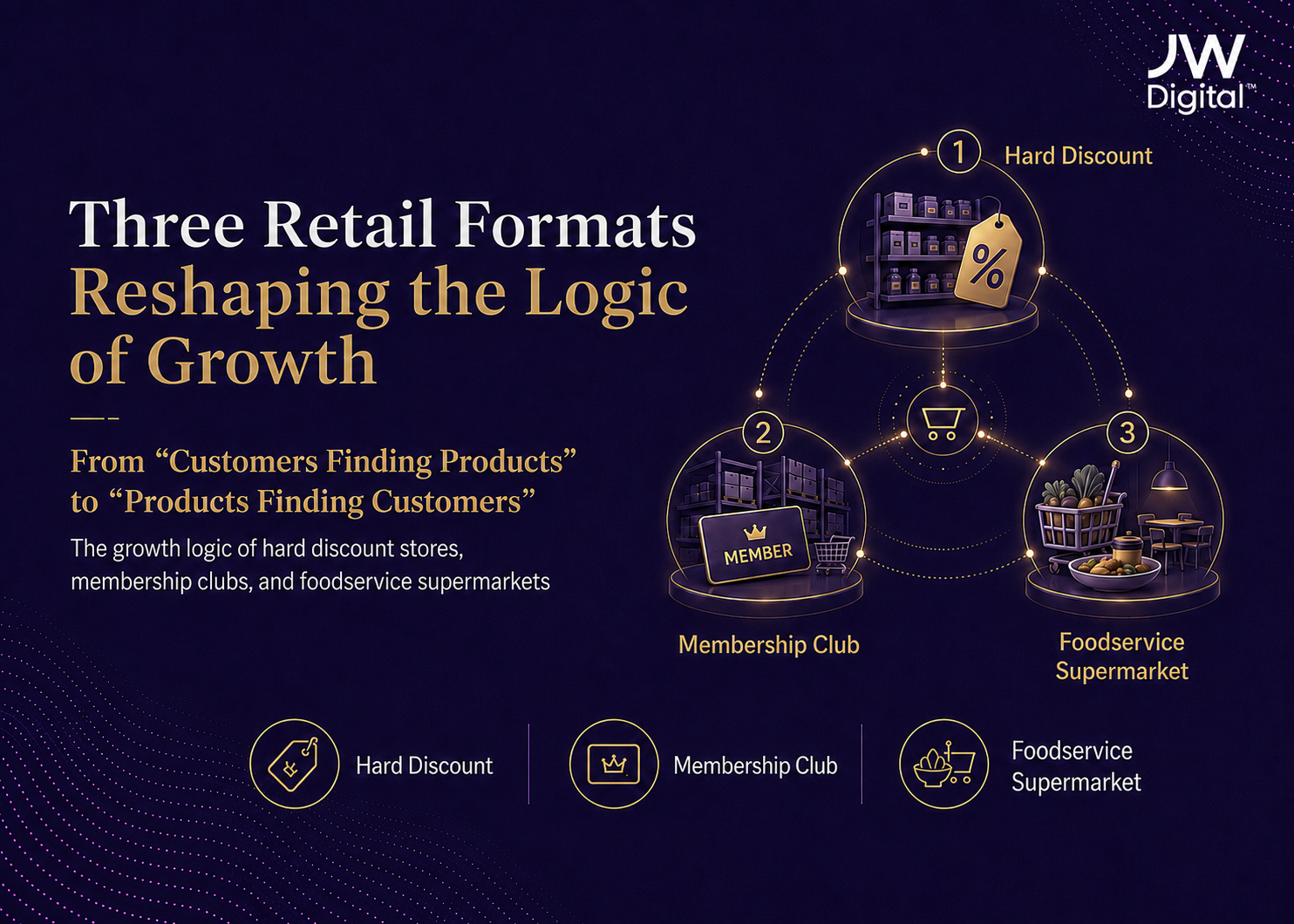
Hard discount stores, membership clubs, and foodservice supermarkets are three representative formats emerging from this shift. Although their models differ, each responds to a distinct consumer expectation: price certainty, value certainty, or immediate convenience.
1. Hard Discount Stores: Rebuilding Price Advantage Through Curated Assortments
The defining feature of a hard discount store is not simply low prices. Its real strength lies in creating a durable price advantage through a simplified assortment and a highly efficient supply chain.
Traditional hypermarkets typically rely on a wide range of SKUs to serve diverse customer needs. However, the larger the assortment, the greater the complexity across procurement, inventory management, and store operations. Hard discount retailers take a different approach. They focus on high-frequency categories, reduce duplication among similar products, and concentrate purchasing volumes on a limited number of core items.
These formats often share several characteristics: a relatively narrow assortment, transparent pricing, a high proportion of private-label products, and highly standardised store operations. Customers do not need to compare large numbers of similar products and can therefore make purchasing decisions more quickly.
Hard discount stores do not merely sell lower-priced products; they offer a clear, consistent, and easily understood price promise.
However, hard discounting is not simply a matter of reducing SKUs or cutting prices. Retailers need strong capabilities in product selection, supplier negotiation, and inventory management. Without a solid supply-chain foundation, a narrower assortment may result in insufficient choice, while low prices may prove difficult to sustain.
The success of the hard discount model therefore depends on whether a retailer can continuously deliver a visible price advantage through better assortment design and greater operating efficiency.
2. Membership Clubs: Building Long-Term Value Through a Prepaid Relationship
Membership clubs use a paid membership model to shift the relationship between customers and retailers from individual transactions to a longer-term commitment.
Consumers are willing to pay a membership fee in advance because they expect continued access to better-value products, more consistent quality, or a more differentiated assortment. For retailers, membership fees provide more than an additional source of revenue. They also help identify core customer groups and create a more stable base of demand.
Membership clubs typically reduce comparison costs through curated assortments, larger pack sizes, and differentiated sourcing. Customers are not required to evaluate a large number of competing brands; instead, they rely on the retailer to make the initial selection on their behalf.
The foundation of a membership model is not the fee itself, but customers’ trust in the retailer’s ability to curate products and deliver sustained value.
This means a membership club cannot succeed by simply placing a paywall around a conventional supermarket offer. If its products, prices, and services are not meaningfully different from those available through ordinary channels, the membership fee becomes a barrier rather than a benefit.
A sustainable membership model must provide value that is genuinely exclusive to members. This may come from unique products, more attractive pricing, dependable quality, or assortments and services designed more effectively for household consumption.
The key competitive challenge is not only attracting customers to join for the first time, but ensuring that members continue to see the fee as worthwhile and are willing to renew.
3. Foodservice Supermarkets: Connecting Products and Experience Through “Buy and Eat”
Foodservice supermarkets combine fresh food retailing with on-site preparation and immediate dining, creating a more integrated, one-stop consumption experience.
The growth of this model is closely linked to the faster pace of urban life. Consumers want fresh, high-quality products, but they also want to reduce the time required for shopping, preparation, and cooking. By combining fresh ingredients with ready-to-eat or freshly prepared food, foodservice supermarkets connect grocery shopping with the need to solve an immediate meal occasion.
Compared with traditional supermarkets, these stores do more than sell ingredients. They participate directly in the customer’s dining experience. Some items can be purchased and taken away, while others can be prepared or consumed in-store, increasing dwell time and purchase frequency.
A foodservice supermarket is not simply a supermarket with a dining area. It reorganises products and services around immediate consumption occasions.
This model also places greater demands on retailers. On-site preparation requires robust food safety management, workforce scheduling, and standardised operating procedures. Fresh-food categories also require effective waste control, demand forecasting, and capacity planning during peak periods.
If foodservice and retail operations are not well coordinated, the business may face both high inventory costs and greater operating complexity. The viability of the model therefore depends on how effectively the retailer connects procurement, production planning, and store traffic—not on the appearance of innovation alone.
Three Formats, Three Forms of Consumer Certainty
There is no single formula for success across hard discount stores, membership clubs, and foodservice supermarkets. Each format addresses a different consumer need.
Hard discount stores offer price certainty. Customers believe they can complete their everyday shopping at lower and relatively stable prices.
Membership clubs offer value certainty. Customers trust that the retailer has already curated the assortment and that membership will continue to provide access to better products and pricing.
Foodservice supermarkets offer occasion certainty. Customers can purchase, prepare, and consume food in one location, reducing both time and decision-making costs.
Although these formats follow different paths, they share one important characteristic: each reduces the burden of choice and creates a clearer store proposition around a specific customer need.
This also explains the shift from “customers finding products” to “products finding customers”. The latter does not simply mean using technology to push more products to consumers. It means understanding the genuine needs of a target customer group first, then organising products and services around those needs.
Format Innovation Must Go Beyond Surface-Level Replication
For retailers, understanding a new format does not mean copying its physical appearance. Reducing the number of SKUs does not automatically create a hard discount model. Introducing a membership card does not establish a true membership proposition. Adding a prepared-food section does not in itself transform a supermarket into a foodservice-led format.
Before selecting a new format direction, retailers should answer three fundamental questions.
First, why does the target customer need this format? The business must identify a sufficiently clear and frequent consumer need, rather than entering simply because the format is gaining market attention.
Second, can the organisation’s existing capabilities support the model? Procurement, supply chain, digital systems, and store operations must all align with the intended format.
Third, can the unit economics be sustained and replicated? A format can support scale only when revenue, cost, and operating complexity are brought into a stable relationship.
A more prudent approach is therefore to begin with the target customer and the relevant consumption occasion. Retailers can then test the assortment, pricing strategy, and operating model on a limited scale before increasing investment based on actual results.
Conclusion
The rise of hard discount stores, membership clubs, and foodservice supermarkets does not mean traditional retail formats will simply be replaced. Their greater significance is that they are forcing retailers to reconsider why a store exists and why consumers would continue to visit it.
True format innovation is not about changing the appearance of a store. It is about redefining the relationship between products, consumers, and consumption occasions.
Future retail competition may not be won by the company with the largest assortment or the biggest store network. It is more likely to favour those that can identify the right customer occasion and build a complete operating model around it.