

A Five-Pillar Framework for Brand Expansion into Southeast Asia
Southeast Asia is becoming an increasingly important destination for Chinese brands pursuing international expansion. The region’s economic scale continues to grow, with the combined GDP of ASEAN member states approaching US$3.9 trillion in 2024. At the same time, Southeast Asia’s digital economy is expected to generate more than US$300 billion in gross merchandise value in 2025, creating new channels and growth opportunities for brands entering the region.
However, Southeast Asia is not a single market that can be addressed with one strategy. Countries differ significantly in purchasing power, cultural preferences, channel structures, regulatory requirements, and supply chain conditions. A product that succeeds in China will not necessarily achieve the same results overseas simply by replicating the same offer, price point, and marketing approach.
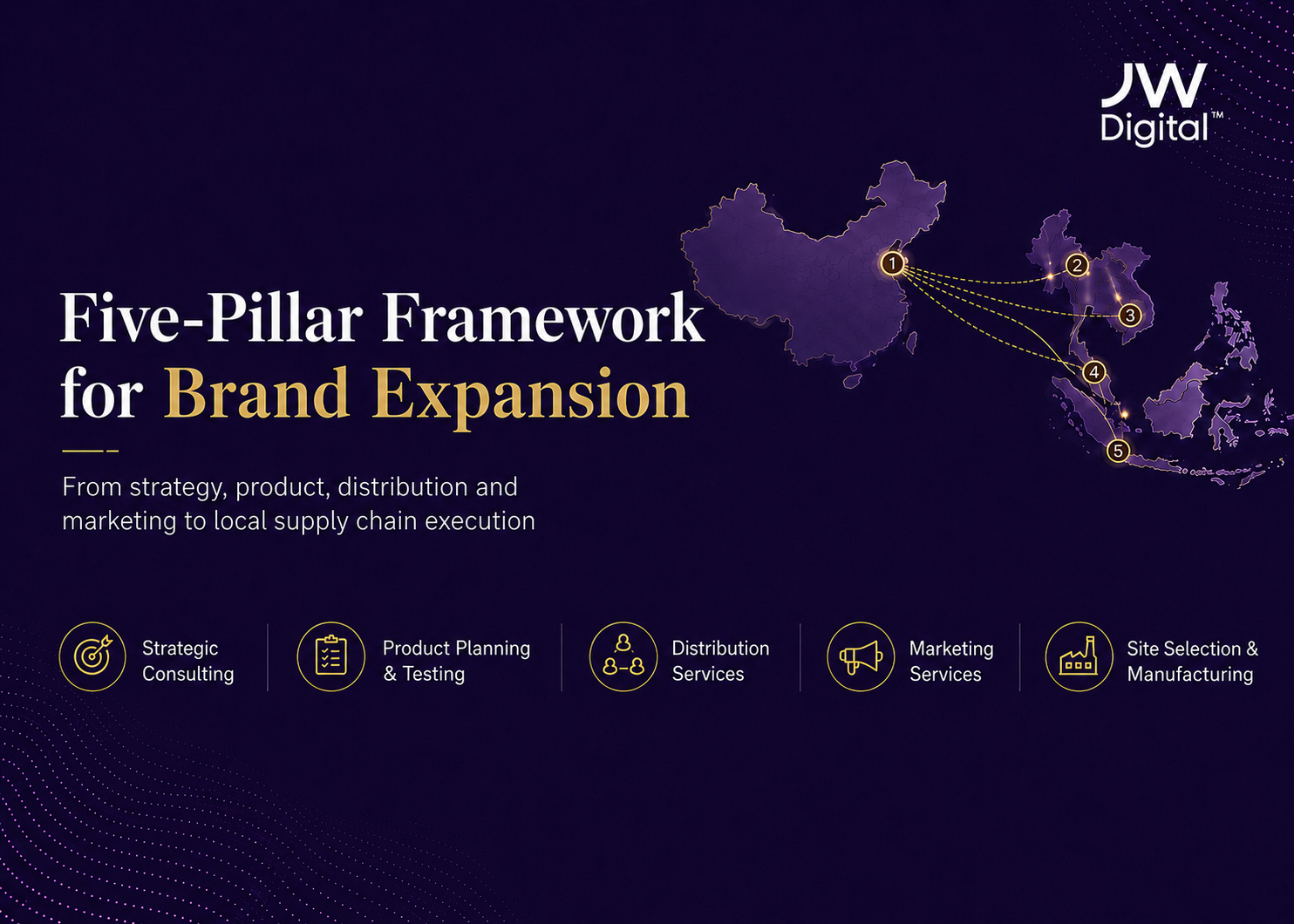
International expansion should therefore not be treated as a one-off sales initiative. It is a strategic undertaking that requires sustained investment, phased validation, and continuous adjustment. Drawing on years of market experience and frontline practice, JWD Group Founder Wang Jing developed the Five-Pillar Framework for Brand Expansion, covering strategy, product, distribution, marketing, and local supply chain execution. The framework helps companies assess how to enter a market systematically and gradually build sustainable local operating capabilities.
These five pillars are not independent workstreams. Strategy determines which market to enter and whom to serve. Product determines whether consumers are willing to buy. Distribution determines whether products can reach consumers consistently. Marketing builds awareness and demand. Local supply chain execution determines whether the business can remain efficient and resilient as it scales.
1. Strategic Consulting: From Entering the Market to Establishing a Lasting Position
The first step in international expansion is not finding a distributor or selecting an e-commerce platform. It is clarifying the company’s strategic intent.
Different objectives require very different resource commitments. Some companies look overseas for a second growth engine. Others aim to absorb excess supply chain capacity. Some see Southeast Asia as a starting point for broader global expansion. Without a clear objective, product selection, channel investment, and organisational arrangements can easily become disconnected.
Companies first need to answer several fundamental questions: Which country should be prioritised? Who are the target consumers? What position should the brand establish in the local market? What relative advantages can the company bring?
The market-entry approach must also match the company’s investment capacity. This includes how long the business can sustain market development, and how much it is prepared to invest in local teams, channel building, and product adaptation.
Relevant research also suggests that a common problem in international expansion is not a lack of opportunity, but unclear objectives or unrealistic expectations for short-term financial returns. Building an overseas business often requires a prolonged period of market development.
The most important output of the strategy stage is therefore not a broad market report, but a clear market-entry logic: which market to enter, how to enter it, which consumers to serve, and what source of competitive advantage to build.
2. Product Planning and Testing: Using Data to Reduce the Cost of Trial and Error
When entering Southeast Asia, many brands begin by taking their best-selling domestic products directly into the local market. This is straightforward, but it often overlooks changes in consumer needs and usage occasions.
Product localisation is not simply a matter of translating the packaging. Flavour, size, functionality, price range, packaging format, and product messaging may all need to be reassessed. Food companies must also consider local dietary habits, religious requirements, and shelf life. Consumer goods companies need to determine whether product features suit the local climate, lifestyle, and channel display conditions.
A product needs to satisfy three conditions at the same time: consumers must understand its value, channels must be willing to sell it, and the company must be able to achieve viable unit economics. A popular product with an unsustainable cost structure will not support stable growth. A competitively priced product without clear demand will face the same problem.
A more prudent approach is to conduct small-scale testing before making a larger commitment. Companies can use consumer research, sample testing, and limited channel pilots to validate demand, price acceptance, and repeat purchase behaviour.
They should also calculate the full net landed cost from production through to local sale, including transportation, tariffs, warehousing, channel fees, and marketing investment.
The purpose of small-scale testing is not to prove that the original product will succeed. It is to identify what needs to change before investment increases, thereby reducing the cost of later correction.
3. Distribution Services: Channel Fit Matters More Than Rapid Listing
Retail channels in Southeast Asia are highly diverse. The maturity of modern retail, traditional trade, convenience stores, e-commerce, and social commerce varies significantly by country. Even within the same market, purchasing journeys can differ widely across cities and consumer segments.
Distribution strategy should therefore not be reduced to finding an agent and listing products as quickly as possible. Companies first need to define the role of each channel. Some channels may be used to establish brand positioning. Others may be better suited to generating early sales, testing new products, or reaching core consumers.
The choice of distribution partner should not be based solely on the number of stores covered. Companies should also assess category expertise, in-store execution, inventory management, data transparency, and financial stability.
A partner with broad coverage but weak execution may create excess inventory and price disorder. A smaller partner with strong focus in the relevant category may be more suitable during the early stages of market entry.
A sound distribution model should also define the channel structure, pricing mechanism, promotional investment, logistics arrangements, and accountability for profit and loss.
What a brand ultimately needs is not short-term listing capability, but a distribution system that can supply the market consistently, maintain price discipline, and be replicated over time.
4. Marketing Services: Building Consumer Relevance, Not Simply Buying Exposure
After entering a new market, the first objective of marketing is not to maximise visibility. It is to help local consumers understand the value the brand offers.
Brand communication developed in the domestic market is usually built on familiar cultural references, usage occasions, and category knowledge. In Southeast Asia, the same communication may lose its original meaning. Translating Chinese advertising into a local language rarely solves the problem.
True localisation requires a deeper understanding of how consumers perceive the category, when they make purchases, and what shapes trust and choice. Brands must then adapt their value proposition, messaging, communication channels, and marketing rhythm accordingly.
Localisation is not translation. It is reconstruction. This does not mean abandoning the core brand position. It means expressing that position in a way local consumers can understand and accept.
Marketing also needs to remain aligned with product and channel strategy. If a product is positioned for the mass market but distributed mainly through premium channels, conversion will be limited. If marketing creates demand before supply and distribution are ready, the resulting experience may damage the brand.
Marketing should therefore not operate as an independent activity. It should progress in coordination with product launches, channel expansion, and inventory planning.
5. Site Selection and Manufacturing: Building a Local Operating Base
For brands seeking long-term growth in Southeast Asia, cross-border exports alone may not support continued expansion. As sales increase, lead times, tariff costs, inventory pressure, and responsiveness to local demand can become major constraints.
Local warehousing, processing, or manufacturing can shorten supply cycles, improve responsiveness, and, under the right conditions, strengthen the cost structure. However, local investment should not be rushed before the market has been sufficiently validated.
Companies need to assess demand scale, cost structure, policy conditions, and supply chain stability before deciding when to move into local production.
Site selection and manufacturing become commercially justified only when demand is relatively stable, sales forecasts have reasonable visibility, and local operations can deliver a clear improvement in cost or efficiency.
Site selection should not be based solely on land and labour costs. Companies also need to consider logistics infrastructure, supplier availability, talent supply, regulatory requirements, and access to target markets.
For companies not yet ready to build their own facilities, local contract manufacturing, shared warehousing, or regional distribution centres may provide a more flexible starting point. Investment can then increase gradually as the business scales.
The purpose of a local supply chain is not simply to reduce cost. It is to bring the brand closer to the market, respond more quickly to demand, and reduce uncertainty in cross-border operations.
The Five Pillars Must Be Advanced as One System
In practice, international expansion rarely follows a perfectly linear sequence. A company may revise its market positioning during product testing. Channel feedback may lead to changes in packaging or pricing. Increased marketing investment may prompt a reassessment of supply chain capacity.
The core value of the Five-Pillar Framework is not to divide international expansion into five departments. It is to help companies understand how different decisions are connected.
Strategy defines the direction of entry. Product testing validates consumer demand. Distribution provides market access. Marketing builds awareness. Local supply chain capabilities support scale.
When any one of these elements is advanced in isolation, investment and market outcomes can easily become misaligned.
Companies can reduce risk by setting clear stage objectives and decision gates. They may begin by validating products and channels in a limited market, then gradually increase marketing and supply chain investment based on actual sales performance.
Compared with pursuing broad coverage from the outset, a phased approach gives companies greater control over risk and preserves room for adjustment.
Conclusion: The Goal Is Not Short-Term Sales, but Sustainable Local Operations
More Chinese brands are entering Southeast Asia, but long-term success will not be determined by launch sales or the number of stores covered in the first phase.
What matters is whether the company can gradually build an operating model suited to the local market.
International expansion is not the simple transfer of a domestic business model overseas. It requires companies to reconsider market positioning, product value, channel structure, consumer communication, and supply chain design.
As JWD Group Founder Wang Jing has noted:
“Going global is not a one-off campaign. It is a strategic undertaking that requires long-term commitment and systematic execution.”
The Five-Pillar Framework for Brand Expansion does not provide a fixed answer. It offers a method for structured analysis and phased decision-making.
Only by connecting the five pillars and adjusting them continuously in response to market feedback can a company move beyond simply entering a market and begin to establish a lasting presence.